
World Cultures Courses in English
The courses listed below are just a sample of the many courses we are offering in SLLC this coming Fall. For a complete list of courses offered each semester in each of our languages, used the search feature below.
Have you ever been to an Oktoberfest in the Midwest or wondered why so many Missourians like Bratwurst? In this course we will seek to answer these and many more questions by delving into the cultural history of Germans and German immigration to the state from the nineteenth century to the present. The purpose of this course is to learn about the cultural history of the state and region and its connections to global histories. This course will speak to students interested in regional tourism and commerce; state and US history; German studies; international studies; refugee and migration studies; and more. We will explore the forces that shaped the lives of German immigrants and their descendants in Missouri: large numbers of German immigrants play formative roles in local and state governments; they are involved in transforming much of the landscape into farmland; they create a wide range of businesses, most notably the many breweries that blanketed the state; they found a variety of churches, settle in religious communities, and establish most of the early synagogues. They are involved in debates about the Civil War and in the build up to the World Wars of the twentieth century. The history of Missouri, in this sense, is part and parcel of both German and American history, and the goal of this class is to allow students to participate in writing it. This is not a typical course based on lectures and discussions. It is based on a joint effort to learn more about German Missouri with a strong component of project-based learning. Students will be encouraged to explore parts of the state and its history, and when applicable, to explore their own family backgrounds as immigrants. As a final project, students will do a history of a specific cultural object, working in tandem with Missouri Humanities and the German Heritage project. Anything used will be credited to students in the displays.
Missouri is home to vibrant Italian American communities, from The Hill in St. Louis, Columbus Park in Kansas City, and Rosati in the Ozark Mountains to our own town, Columbia. These communities have shaped the state's cultural, economic, and intellectual life through restaurants, businesses, festivals, education, and the arts. Students will examine the histories and impact of these communities within the economic, political, and social context of the larger framework of Italian immigration to the United States. Using memoirs, oral histories, and archival research at the State Historical Society of Missouri (SHSMO). Through targeted project-based learning, students will examine how Italian American culture is preserved and celebrated. Experiential components include visits to The Hill, Columbia's Italian businesses, and archival collections. Recommended: Sophomore standing or ENGLSH 1000.
Cross-listed with FILM_VS 3861 and DST 3005
This course offers a historical overview of Italian Cinema from the silent era to the present. The course will provide the analytical skills necessary to read and critically analyze a film. Social and historical issues will be raised and examined for each film as appropriate. No knowledge of Italian required. Prerequisites: sophomore standing. (Same as FILMS_VS 2850).
Survey and analysis of selected Japanese films from the 1940s to present. Films will be viewed and discussed in terms of history, techniques, artistry, and social impact. English subtitles. No foreign language credit. Prerequisites: sophomore standing or instructor's consent.
Students in this class will gain a basic understanding of the people, culture, and nation of present-day China. Since the present cannot be understood without knowledge of the past, we will approach this goal by building knowledge of China's history, traditional religions, philosophy, arts, literature, food, customs, and language with a focus on how these traditional aspects of Chinese culture are manifested in and influence modern day China.
The course is divided into 3 broad themes: Traditional China, Modern China, and Life and Arts in China. Since this is a survey course, it is also hoped that students will come away with a desire to explore the subject more deeply.
Lecture course with Friday breakout sessions (either WI or non-WI) on the development of German civilization from the ancient Germanic migrations to the early nineteenth-century Napoleonic invasions. This course combines history, mythology, philosophy, art, architecture, and literature in pursuit of the complex question of German cultural and national identity. Some of the important figures, phenomena, and events covered include the conflict between Germania and the Roman Empire, the Age of Chivalry, the medieval epic The Song of the Nibelungen, Gothic and Baroque architecture, Martin Luther and the Protestant Reformation, the Age of Enlightenment, the rise of Prussia, Goethe’s Faust tragedy, Romantic painting and poetry. Conducted in English and assumes no knowledge of German.
This course provides a broad survey of the history, culture and current events of modern Latin American. Topics include indigenous cultures before and since the Spanish conquest, the struggle for independence, the contributions of Afro-Latin Americans, revolutions and social movements in the 20th and 21st centuries, relations with the US, emigration, the War on Drugs, the effects of the pandemic and so much more.
We will start with the Caribbean and proceed from Mexico to Central and then South America. For each country featured, we will cover flashpoints in history, along with contemporary issues key to understanding the country today. In addition, we’ll learn about the greatest musical, artistic and literary figures of the continent. Class materials will include book excerpts, news articles, music videos, documentary and feature film clips and guest lectures from other MU Spanish faculty.
Open to any student interested. No knowledge of Spanish required. Counts toward general humanities requirement. May not be included in area of concentration in Spanish.
This course provides a broad survey of the history, culture and current events of modern Latin American. Topics include indigenous cultures before and since the Spanish conquest, the struggle for independence, the contributions of Afro-Latin Americans, revolutions and social movements in the 20th and 21st centuries, relations with the US, emigration, the War on Drugs, the effects of the pandemic and so much more.
We will start with the Caribbean and proceed from Mexico to Central and then South America. For each country featured, we will cover flashpoints in history, along with contemporary issues key to understanding the country today. In addition, we’ll learn about the greatest musical, artistic and literary figures of the continent. Class materials will include book excerpts, news articles, music videos, documentary and feature film clips and guest lectures from other MU Spanish faculty.
Open to any student interested. No knowledge of Spanish required. Counts toward general humanities requirement. May not be included in area of concentration in Spanish.
As political, business, religious, and personal encounters between Chinese and Americans increase, so also does the need for competence in negotiating these cross-cultural interactions. Course addresses issues related to American and Chinese cross-cultural communication in five spheres of interaction: political, religious, business, interpersonal, education. Through related readings, discussions, and structured conversations with Chinese, students will explore how this information and a deeper understanding of Chinese and American culture can be applied to more fruitful and positive cross-cultural interactions in multiple contexts. Prerequisites: sophomore standing.
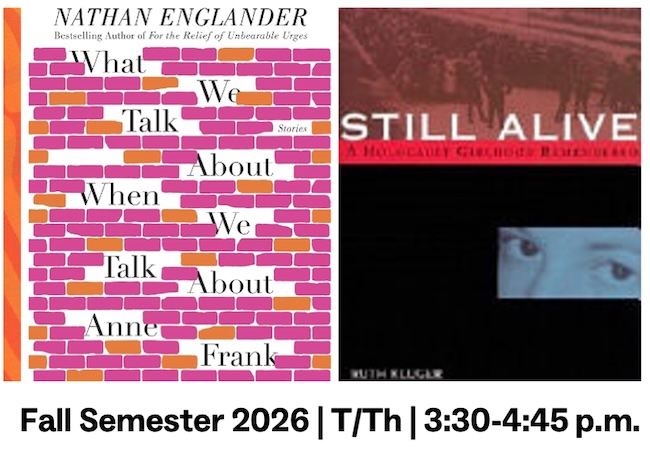
(Cross-listed with English 3110-06)
How do we represent an event that many survivors claimed was beyond human comprehension? This course examines the diverse literary responses to the Holocaust, moving from the immediate testimony of survivors to the imaginative reconstructions of contemporary writers.
This course explores the intersection of Italy's cultural identity, globalization, and regional traditions through the lens of food, sports, and the arts. Students will analyze how these cultural elements shape national and regional identities, influence transnational migration and adaptation, and reflect broader social and economic changes. Graded on A-F basis only.
This course examines the security challenges facing East Asia through the framework of international relations. We will explore the historical and political dynamics among key countries in the region, including China, North Korea, South Korea, the United States, Japan, Taiwan, and Russia, as well as the current security landscape. The course is divided into two phases. In the first phase, we will analyze the core characteristics of states that play significant roles in international affairs, focusing specifically on territory, population, and sovereignty. Understanding these foundational elements will help us grasp each state's position and behavior within the international system. We will also examine interstate relations in East Asia, particularly China's interactions with its neighbors. In the second phase, we will conduct a detailed analysis of ongoing security issues in the region. Key topics will include the North Korean nuclear crisis, cross-strait relations, disputes in the South China Sea, territorial conflicts, and the arms race among regional states.
(same as PEA_ST 3510HW). This interdepartmental course serves as one of the core seminars for students pursuing the undergraduate Certificate in Digital Global Studies. The course focuses on the impact of technological change and globalization on cultures around the world from various interdisciplinary perspectives. The course is open to students in any discipline. Graded on A-F basis only. Prerequisites: Sophomore standing; 2.75 GPA or instructor's consent.
(same as PEA_ST 4810). This inter-departmental course examines the ways in which people across the globe are affected every day by an unprecedented array of linkages that defy geographic and political boundaries. Also serves as one of the seminars for the certificate in Digital Global Studies. Graded on A-F basis only. Prerequisites: Sophomore standing; 2.75 GPA or instructor's consent.
(same as INTL_S 4940). This course provides an intercultural communication framework for students exploring global career pathways through internships in multicultural or multilingual organizational settings in the US or abroad. Readings and course assignments will guide students to critically reflect on cultural dynamics, communication styles, and global competencies to enhance their understanding and effectiveness in multicultural professional environments. Students will also explore and refine their career readiness through resume building, informational interviews, and skills assessments, with an emphasis on NACE competencies. Prerequisites: Instructor consent required.
A survey of Russian culture and history from the pre-Christian era to the present. Topics will include politics, religion, philosophy, literature, music, and visual art.
What does it mean to live - and die - with purpose? Through the works of Fyodor Dostoevsky and Lev Tolstoy, two of the most influential writers of 19th-century Russia, this course explores themes of morality, freedom, faith, and the human condition while also situating the texts within their historical and intellectual contexts. Students engage in close reading and analytical discussion to understand how these seminal authors and texts interrogate life's ultimate questions, and how they continue to shape literary and philosophical thought beyond their original Russian context. Recommended: Sophomore standing.
Search All Courses by Subject
To see a complete list of courses offered in each subject by semester, you can search using the public Access myZou page. If you are a student, you can find the same information in your myZou Student Center.
*Hint - If you want to see all the courses for a given subject, select the subject, and for "Course Number" choose "greater than or equal to" and write "0".